What a Service NSW driving test actually assesses
The routes are not published, and memorising one would not help you anyway. Here is what the assessor is marking, and what is genuinely worth preparing.

Every week someone asks for the test route. It is one of the most searched questions about the NSW driving test, and the honest answer disappoints people: Service NSW does not publish test routes, and there is no official list of them anywhere.
Assessors work from the roads around the centre you have booked. Those roads are chosen because between them they cover what the criteria require — intersections of different types, a range of speed zones, merging, and somewhere to ask for a manoeuvre. Which combination you get on the day is not something you can know in advance.
The strategy problem
Why memorising a route would not help
Suppose you had one. The test is an assessment of driving behaviour, not of local geography, so knowing which street comes next changes nothing about what is being marked.
It can actively hurt. A driver who knows a turn is coming starts behaving as though it has already been announced — slowing early, drifting toward the turn, checking mirrors for a movement the instruction has not yet asked for. That reads as driving to a memorised script instead of responding to the road, and the responding is the thing under assessment. Treat that as instructor interpretation rather than a published rule, but it is a pattern worth avoiding.
What is marked
The things an assessor is actually watching
These do not change between centres, and they do not change with the route:
Under assessment
- Observation. Mirrors, head checks before every move, and scanning far enough ahead to see a situation forming.
- Gap selection. Whether the gap you take is genuinely there, at intersections, roundabouts and merges.
- Speed for the conditions. Not just the posted limit — school zones, wet roads, pedestrians, and traffic that has slowed for a reason you have not spotted yet.
- Road position and lane discipline. Including which lane you should be in well before you need it.
- Signalling. Early enough to inform, not so early it misleads.
- Following distance. The gap you keep, and whether it survives someone cutting into it.
- Response to hazards. What you do about the thing that develops, rather than whether you noticed it afterwards.
- Manoeuvres, as directed. Performed under instruction, in real traffic conditions.
Some errors end the test immediately regardless of how the rest went. The current list of those, along with eligibility and what to bring, is published on the NSW driver licence tests page. That page is the authority; this one only explains how the assessment works in practice.
What to do instead
Prepare the road types, not the roads
This is where local knowledge genuinely helps — not as a route, but as a list of conditions. Before your test, make sure you have driven, repeatedly and recently:
A multi-lane roundabout at a busy time. An arterial road where the traffic is moving at 60 or 70 and the gaps are short. A school zone during its hours. Unmarked residential intersections, which catch out more learners than anything else on this list. A hill start on a real hill. A right turn across oncoming traffic without a green arrow.
If all six are comfortable, the specific streets stop mattering. That is the whole point.
Around here
Liverpool and Campbelltown
Tests in this part of Sydney are booked through Service NSW, which also handles the separate Hazard Perception Test.
The Liverpool centre sits inside a busy retail precinct, which means the roads immediately around it carry shopping-centre traffic — cars leaving parking, pedestrians crossing mid-block, and buses. Campbelltown sits in the Macarthur area, with a different mix: more of the newer arterial roads and roundabouts that have gone in as the area has grown.
Neither is easier. They ask slightly different questions of the same skills, which is another reason the route matters less than people hope.
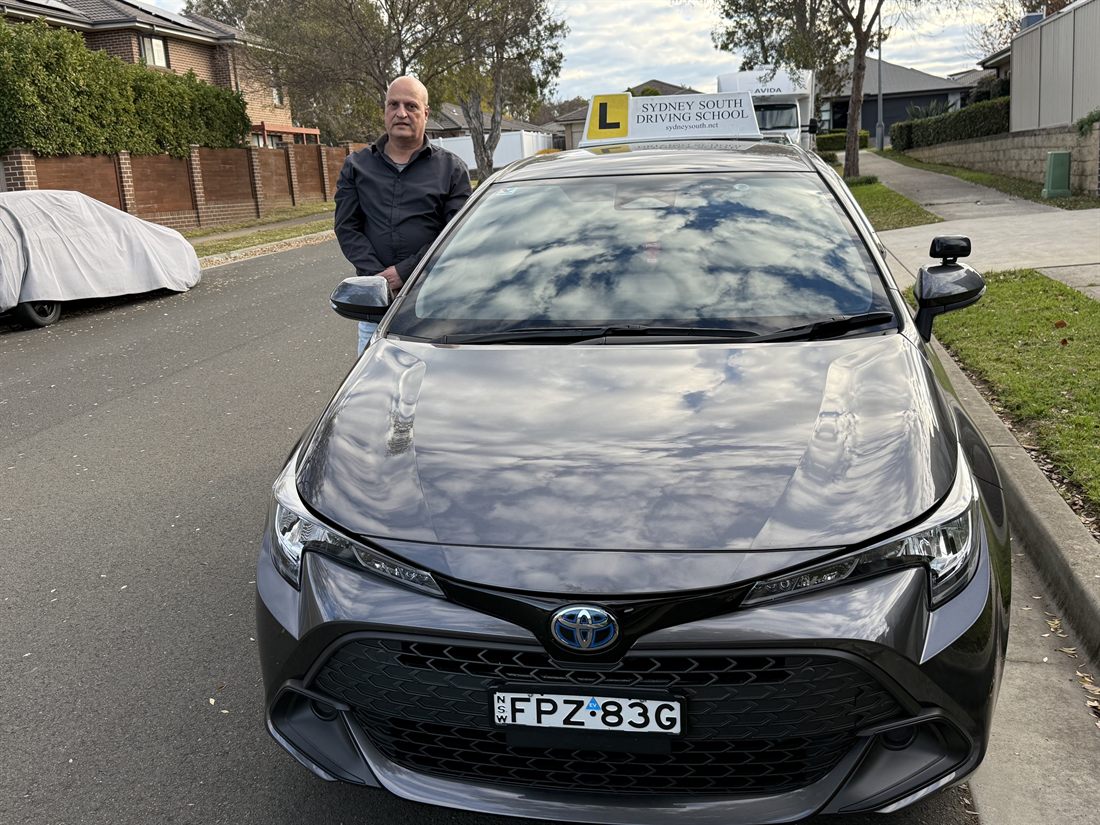
George Hany · Senior Driving Instructor
Lessons around Campbelltown are taught by George, an instructor since 2005 who came to it after years of teaching at TAFE NSW and in high schools. He holds a Graduate Diploma in Education from ACU, a Masters of Building Science from Victoria University of Wellington, and a Bachelor of Town Planning.
One practical note. Book the centre whose surrounding roads you have actually practised on. Choosing a centre because it has a reputation for being quiet, in an area you have never driven, trades a small advantage for a large one.
Questions
What learners ask about test routes
-
Are NSW driving test routes published anywhere?
No. Service NSW does not publish test routes, and no official list exists. Anything presented online as "the" route for a centre is someone's reconstruction, not an official document.
-
Does the assessor use the same route every time?
Not reliably. Assessors work from the roads around the centre and the criteria they need to cover, and conditions on the day change what is practical. Treat any claimed fixed route as instructor interpretation rather than fact.
-
Is one test centre easier than another?
The assessment criteria are identical at every centre. What differs is the mix of roads around it. Book the centre whose surrounding roads you have practised on, rather than the one with a reputation.
-
What happens if I take a wrong turn during the test?
Going a different way than instructed is not the thing being marked, how safely you handle it is. Keeping your observation and positioning correct while you recover matters more than the turn itself. The official error criteria are published by Transport for NSW.
-
Is the Hazard Perception Test part of the driving test?
No. The Hazard Perception Test is a separate computer-based test, booked through Service NSW, that measures how you spot developing hazards. The practical driving test is a separate booking assessed in a car.
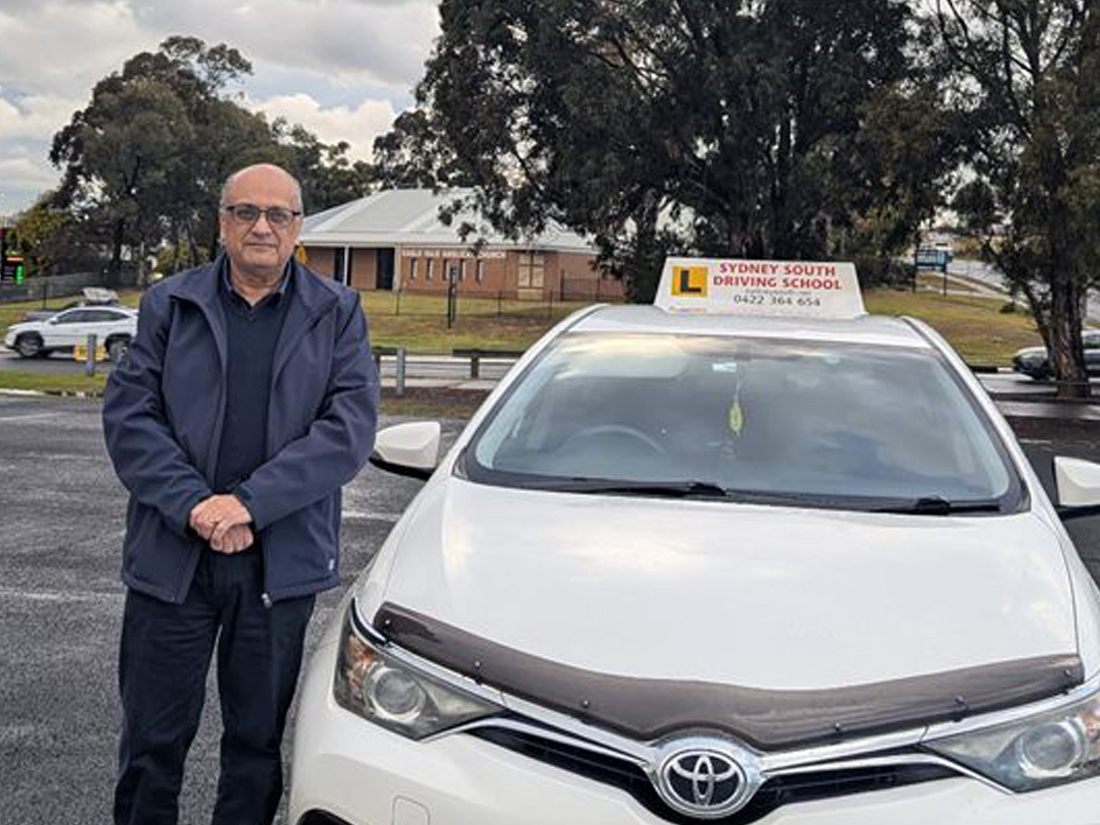
Senior driving instructor at Sydney South Driving School since 2013, with a Bachelor of Commerce and a professional background in accounting and five-star hospitality. More about Ashraf